Cookware Sets Philippines: What to Check Before Buying for a Small Kitchen
About this guide
The SulitScan editorial team prepares buyer guides using desk-researched product information, primary guidance where available, and practical pre-purchase checks. We do not claim hands-on testing unless an article explicitly says a product was tested.
In this guide
A cookware set in the Philippines is a better buy when its material suits how you cook and every counted piece has a job. The bases should match your stove, and the largest pan must fit your burner and cabinet. Check dimensions, handle design, lid count, care instructions, checkout total, and return terms before treating a large piece count as value.
Quick answer
List the meals and cookware you use in a normal week. Choose the smallest set that covers those jobs without duplicating pieces you already own. Confirm the material and coating description, base compatibility with your actual stove, body and handle dimensions, usable capacity, and what the seller counts as a piece. Read the maker's current use and care instructions plus the seller's damage and return process before ordering.
Cookware sets in the Philippines: set or individual pieces?
Choose a set when
- You are starting with little usable cookware and need several different vessel sizes.
- The listed pots and pans match meals you regularly cook.
- Shared lids or removable handles reduce storage without making daily use awkward.
- The complete set fits your burners, sink, drying area, and cabinet.
- The final total and return route compare well with buying the same useful pieces separately.
Choose individual pieces when
- You need one specific pan or pot to fill a gap.
- A set duplicates sizes you already own or includes tools you would not use.
- You want different materials for different cooking jobs.
- Your kitchen cannot store the complete set without unstable stacking.
- You want to replace one worn item without changing the rest of your cookware.
Count functional vessels separately from lids, protectors, utensils, and detachable handles. A listing described as a seven-piece set may not contain seven pots and pans. Write down each included item and assign it a real cooking job; an item without a job is not added value.
Browse home finds and items under ₱1,000 for current catalog options. The budget page is a filter, not a claim that every useful cookware set must fall below that amount.
Material, stove, and dimension checks
Read the listing's material description for the body, cooking surface, base, handle, and lid. Do not infer the full construction from a word in the title or the color of a product photo. If a coating, metal grade, or layered base matters to you, look for a clear maker specification for the exact model.
Check compatibility against your stove: gas, induction, electric coil, or another surface. "Induction compatible" is a listing claim to verify in the maker's current specifications and recent reviews for the exact variation. Also compare the flat base diameter with the burner or cooking zone instead of using the rim diameter alone.
Capacity labels do not tell you whether a pot fits your sink, refrigerator, or cabinet. Record the rim diameter, body height, base width, total length with the handle, and height with the lid. Allow clearance for knobs, shelves, doors, and neighboring cookware.
Small-kitchen measurements
Measure the cabinet's internal width, depth, and height. Measure the widest opening on the route into the cabinet and the drawer height if handles must lie flat. Then map the listed cookware dimensions onto that space with paper, tape, or cookware you already own.
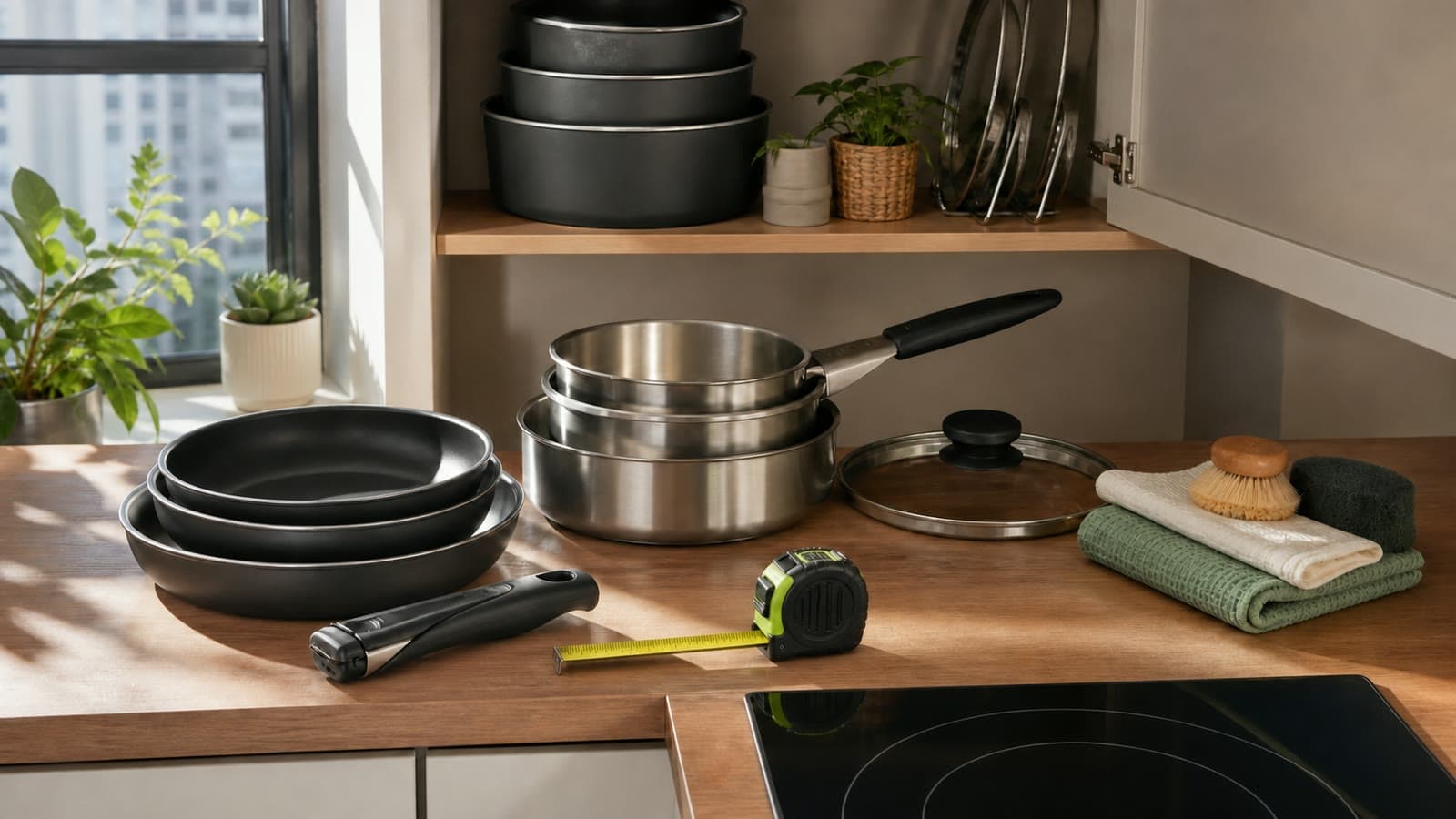
For nesting sets, check whether pans truly nest with lids and protectors in place. Stacking saves shelf area but can make the bottom pan inconvenient to reach. A removable handle can reduce total length and help a pan move between stove, table, and storage. Its attachment mechanism also needs clear locking, use, cleaning, and replacement instructions.
Before choosing a removable-handle set, ask whether it can stay attached during your usual cooking tasks. Consider whether two vessels may need handles at the same time and where the loose handle will be stored. Follow the maker's current load, attachment, heat, and use instructions; do not assume another brand's directions apply.
Our home-organization guide offers a measure-first method for shelves, racks, and storage bins around a small kitchen.
Coating, handle, and lid care
Use the maker's current instructions for initial washing, heat settings, preheating, utensils, oil, cleaning method, dishwasher use, stacking, and replacement. Coatings and constructions differ, so a generic social-media care rule should not override the directions for the exact product.
Check how the handle is fastened and what the maker says about tightening, oven use, heat exposure, and replacement. For a detachable handle, inspect and clean the connection as directed. Stop using a loose or damaged component and contact the maker or seller for the model-specific next step.
For lids, verify the material, fit, knob or handle attachment, vent design if present, and care directions. Read reviews for reports of poor fit, trapped residue, loose hardware, or damage in transit. Those reports help identify questions to ask; they do not prove every unit will behave the same way.
Overseas orders: total cost and possible import charges
When ordering from Temu or another overseas seller, compare the complete checkout total, dispatch origin, delivery estimate, parcel tracking, and return route. SulitScan's independent Temu shopping guide is educational only and no longer contains Temu affiliate listings. A low item price may sit beside shipping, platform fees, or charges that appear only after the basket is assembled. Shopee PH also mixes seller and fulfillment arrangements, so confirm whether the selected listing ships locally or across borders.
The Philippine Bureau of Customs publishes official importation guidance covering duties, taxes, exemptions, and entry rules. The treatment of an order can depend on its value, goods, shipment, and current regulations, so confirm official guidance for the actual order instead of relying on a product-page estimate.
For a planning figure, ImportTaxPH is a free SulitScan sister tool that can estimate possible Temu import costs. It is not a government calculator, customs ruling, or guarantee of the amount due. Recheck the partner checkout and Bureau of Customs information before ordering.
If you are buying a powered kitchen appliance rather than cookware, use the energy-efficient appliance buying guide to compare the exact model, DOE label, running-cost estimate, fit, installation, and warranty.
How we assessed this guide
We followed the SulitScan editorial policy and reviewed the Home catalog for cookware, kitchen, pan, pot, and storage signals. Eligible recommendations must be active, below the suspicious-discount threshold, and aligned with those assigned category and tag signals; the page shows no more than three. We compared listing evidence and decision factors only. We did not physically cook with, measure, or certify the products.
Cookware buying checklist
- List the pots and pans used in a normal week.
- Count vessels separately from lids, handles, protectors, and utensils.
- Confirm material, surface, base, stove compatibility, and maker specifications.
- Measure burners, sink, drying space, cabinet, and route into storage.
- Read current instructions for coating, handle, lid, cleaning, and stacking care.
- Check recent reviews for the exact size and variation.
- Compare the final delivered total and possible import treatment.
- Read damage, missing-piece, and return terms before payment.
Affiliate disclosure
SulitScan may earn a commission when you click a partner link and complete a purchase, at no extra cost to you. We do not physically test every cookware item or provide product certification, customs advice, or a safety guarantee. Prices, specifications, stock, reviews, delivery, import treatment, and return terms can change. Follow the maker's current instructions and confirm official information for your order. See our full Affiliate Disclosure.
Frequently asked questions
Is a large cookware set better value than buying separate pans?
Only when most pieces match cooking jobs you perform and fit your stove and storage. Count vessels separately from lids and accessories, then compare the final total with the useful pieces bought individually.
How do I know whether cookware works on my stove?
Check the maker's current compatibility specification for the exact model and compare the flat base diameter with your burner or cooking zone. Do not rely only on a marketplace title.
Are removable handles practical in a small kitchen?
They can reduce stored length, but the locking mechanism, handle availability, load instructions, cleaning, and replacement route add trade-offs. Check how you cook and follow the maker's current directions.
What dimensions should I check before buying a cookware set?
Check rim diameter, flat base width, body height, total length with handles, height with lids, and the nested storage footprint. Compare them with your burners, sink, drying area, and cabinet clearances.
Can ImportTaxPH tell me the exact charge on an overseas cookware order?
No. ImportTaxPH is a free non-official sister-tool estimate. Customs treatment depends on the actual order and current rules, so confirm the checkout and Bureau of Customs guidance.
Tags
Get weekly sulit finds in your inbox
Shopping tips, price-check reminders, and the best deals, free.
More shopping guides

Explore SulitScan