Energy-Efficient Appliance Buying Guide Philippines
About this guide
The SulitScan editorial team prepares buyer guides using desk-researched product information, primary guidance where available, and practical pre-purchase checks. We do not claim hands-on testing unless an article explicitly says a product was tested.
In this guide
- How we assessed this guide
- Match the label to the exact model
- Compare similar capacity and use cases
- Estimate running cost with your own rate
- Check fit, installation, and electrical details
- Verify the online listing before paying
- Compare warranty and service access
- Appliance comparison worksheet
- Final appliance-buying checklist
- Affiliate disclosure
The cheapest appliance at checkout is not always the lowest-cost appliance to own. Refrigerators, air conditioners, televisions, and other frequently used equipment can add years of electricity cost, while an oversized or poorly matched model can waste money even when its efficiency rating looks good.
This Philippine buyer guide explains how to use the model-specific energy label as one part of a complete online-purchase decision.
How we assessed this guide
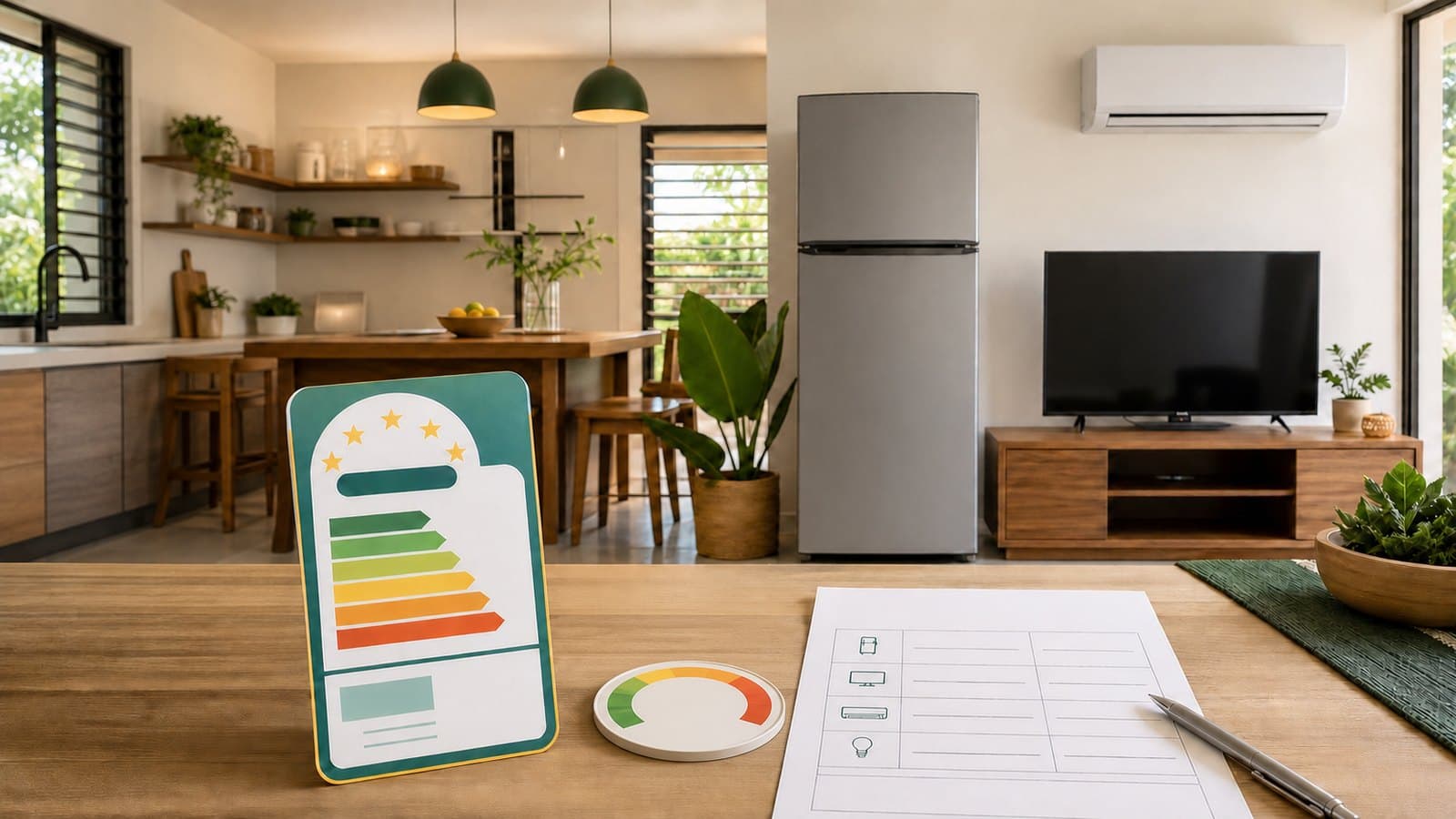
We used the Department of Energy's explanation of the Philippine Energy Label. The label includes a star rating tied to product efficiency, model details, estimated energy consumption, and a QR code for more information: DOE Philippine Energy Label.
The DOE also maintains the Philippine Energy Labeling Program product information system. Buyers can use the official PELP portal to look for model-specific records where available.
SulitScan does not test appliances, certify safety, calculate your utility bill, or guarantee that a marketplace photo is the current official label. Coverage and requirements differ by product type and can change, so confirm current DOE information and the exact model before paying.
Match the label to the exact model
Do not compare a label shown for a different capacity, suffix, or product generation. Record the complete model number from the listing, product label, and DOE record. A family photo can show several sizes while the efficiency and consumption figures apply to only one.
On the energy label, check:
- Brand and complete model number
- Product type and rated capacity
- Star rating or efficiency information
- Estimated energy consumption and the test basis
- Label issue or validity information where shown
- QR code or official product-detail reference
If the seller shows a blurry label or only says “inverter” or “energy saving,” ask for the exact model and current label. Marketing words do not replace model-specific consumption information.
Compare similar capacity and use cases
Efficiency comparisons make sense only between appliances that can do the same job. A small refrigerator may use less electricity but be too small for the household, leading to crowding, poor airflow, or a second appliance. An oversized air conditioner can cost more and may not suit the space even if it has a strong rating.
Define the need first:
- Room size, heat exposure, occupants, and normal use for cooling
- Household size, food habits, and storage layout for refrigeration
- Viewing size, brightness, and daily hours for televisions
- Load size and weekly cycles for washers or dryers
- Required capacity and frequency for other covered equipment
Compare products within the same useful-capacity range. Then use energy information, warranty, service support, noise, dimensions, and price to choose among them.
Estimate running cost with your own rate
When the label provides monthly or annual energy consumption in kilowatt-hours, multiply that figure by the electricity rate you want to use.
Estimated monthly electricity cost = monthly kWh × pesos per kWh
For example, if a model's label estimates 30 kWh per month and you use an assumed rate of ₱12 per kWh for planning, the estimate is ₱360 per month. This is not a bill prediction. Actual use can change with temperature, settings, maintenance, loading, household behavior, voltage conditions, and the utility's current rate and charges.
Use the same assumed rate and label basis for every model in your comparison. Do not mix daily, monthly, and annual consumption without converting them to the same period.
Calculate a multi-year planning total, but keep it clearly labeled as an estimate:
Purchase price + delivery and installation + estimated energy cost + expected maintenance
This makes a higher upfront price easier to evaluate without pretending the future is certain.
Check fit, installation, and electrical details
Measure the appliance and the complete delivery route. Include packaging size, doorways, stairs, elevator, turning space, ventilation clearance, door swing, hose or drain location, and access for cleaning or service.
Confirm:
- Rated voltage and frequency for Philippine use
- Plug type, grounded outlet, and required circuit or breaker
- Installation parts and labor included or excluded
- Ventilation and manufacturer clearance requirements
- Water, drain, exhaust, mounting, or outdoor-unit needs
- Delivery floor, stairs, haul-away, and building rules
Do not solve an electrical mismatch with an unverified cheap adapter or extension. Use the manufacturer's instructions and a qualified professional where the installation requires one.
Verify the online listing before paying
Save the exact model, energy-label image, capacity, dimensions, color, included parts, warranty, seller identity, and service-center information. Confirm whether the item is local stock, gray market, display, open-box, or refurbished because that can affect warranty and label interpretation.
Check recent reviews for noise, fit, delivery damage, missing accessories, and seller support, but use the online product review checklist rather than relying on the star average.
For kitchen equipment, the cookware buying guide helps separate cookware compatibility from appliance claims. For covered electrical products, use the PS and ICC appliance-safety workflow to check certification records, the exact model, voltage, plug condition, and seller evidence. For a first home, use the first apartment essentials guide to decide whether the appliance is a current need or a later upgrade.
Compare warranty and service access
An appliance can be efficient and still be a poor online purchase if service is impractical. Ask who honors the warranty, where the nearest authorized service option is, which parts and labor are covered, and who pays transport for a large unit.
Save the warranty terms before checkout. On delivery, inspect the carton, verify the model and serial reference, keep the official receipt, and follow registration instructions. Do not discard packaging until the item is installed, tested, and outside any immediate return check.
Consider parts availability, filter or consumable cost, cleaning access, and technician availability. Energy use is only one part of ownership cost.
Appliance comparison worksheet
For each candidate, record:
- Exact model and useful capacity
- Official energy-label record and estimated kWh
- Planning electricity rate and estimated monthly cost
- Purchase, delivery, installation, and accessory cost
- External dimensions, package size, and required clearances
- Electrical, water, drain, exhaust, or mounting needs
- Warranty provider, coverage, service location, and transport responsibility
- Noise, maintenance, filters, parts, and consumable costs
- Return window and delivery-damage process
Final appliance-buying checklist
- The DOE label and listing refer to the exact same model.
- I compared models with equivalent useful capacity.
- I converted consumption to the same time period and used one planning rate.
- I measured the final location and delivery route.
- Electrical and installation requirements are confirmed.
- Delivery, installation, haul-away, and building fees are included.
- Warranty and local service access are practical.
- I saved the listing, energy label, receipt, serial details, and seller answers.
- I can afford the total ownership estimate, not only the discounted checkout price.
Affiliate disclosure
SulitScan may earn a commission when you click an eligible partner link and complete a purchase, at no extra cost to you. We do not energy-test, safety-certify, install, repair, sell, or guarantee appliances. Labels, models, rates, consumption, prices, stock, warranty, and service terms can change. Verify the current DOE record, manufacturer instructions, and seller terms. See our full Affiliate Disclosure.
Frequently asked questions
Does a higher Philippine Energy Label star rating always mean the appliance is best for me?
No. Compare the exact model with similar useful capacity, then consider consumption, fit, installation, warranty, service, noise, and total cost.
How do I estimate an appliance's monthly electricity cost?
Multiply the label's estimated monthly kWh by a chosen peso-per-kWh planning rate. Use the same basis for each model and treat the result as an estimate, not a bill prediction.
What if an online appliance listing does not show a readable energy label?
Ask for the exact model and current label, then check the official DOE PELP information where available. Do not substitute a label from another size or model.
Tags
Get weekly sulit finds in your inbox
Shopping tips, price-check reminders, and the best deals, free.
More shopping guides

Explore SulitScan