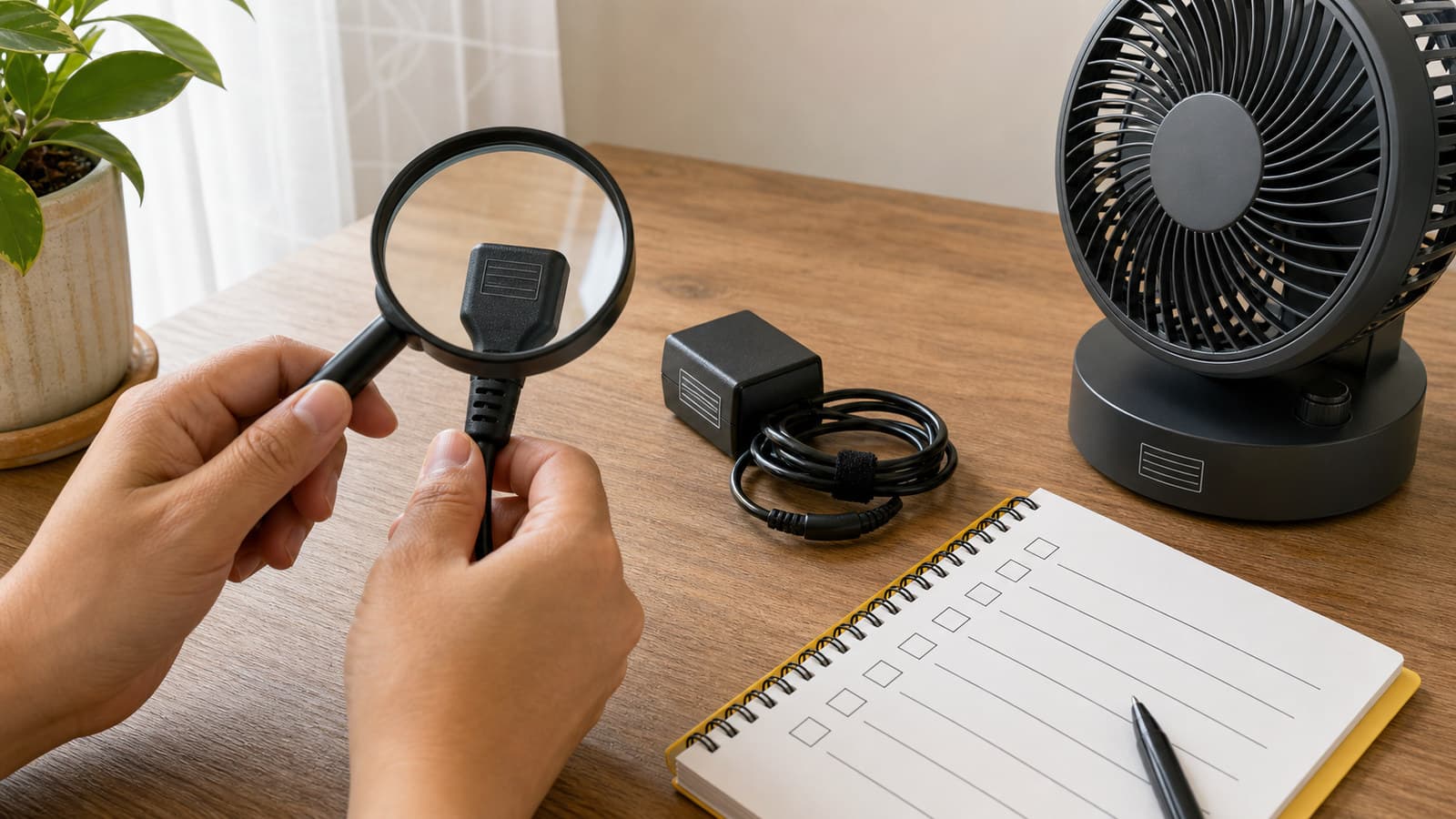
Online Electrical Appliance Safety: PS and ICC Guide Philippines
About this guide
The SulitScan editorial team prepares buyer guides using desk-researched product information, primary guidance where available, and practical pre-purchase checks. We do not claim hands-on testing unless an article explicitly says a product was tested.
In this guide
- How we assessed this guide
- First decide whether the product is covered
- Understand PS and ICC without oversimplifying
- Verify the exact mark, model, and responsible business
- Check safety details beyond certification
- Worked PS-or-ICC decision
- Verify the seller and listing evidence
- Inspect delivery before first use
- Electrical appliance safety checklist
- Limitations and live-policy check
- Affiliate disclosure
A PS mark, ICC sticker, or QR image can be a useful checkpoint when buying an electrical appliance online in the Philippines. It is not enough to judge a product from a blurry seller photo or to assume every electrical item follows the same certification route.
This workflow starts with the current mandatory-product list, then connects the mark or sticker to the exact model and seller before checking voltage, plug condition, installation, warranty, and recall information.
How we assessed this guide
We reviewed the DTI-Bureau of Philippine Standards live list of products under mandatory certification, the official explanation of PS and ICC marks, and the DTI-BPS product certification overview.
We also checked the DTI-BPS certified-products resources and a DTI enforcement report involving unsafe appliances and misleading or nonconforming marks.
SulitScan does not inspect, electrically test, certify, install, repair, or recall products. Certification coverage and records can change. Use the current official list and verification channel for the exact model rather than a copied count or marketplace claim.
First decide whether the product is covered
Only product types under a current mandatory certification scheme require the applicable PS mark or ICC sticker. Do not demand one from every electrical or electronic product, and do not assume that an unlisted product has been certified merely because it plugs in.
The current live list includes many household appliances and electronics, lighting and wiring devices, plugs and socket-outlets, extension cord sets, flexible cords, wires, and cables. Coverage can be defined by product type, standard, scope, or technical characteristics, so compare the listing with the current official entry.
Record the exact product type, brand, full model, rating, and intended use. If the seller uses a broad phrase such as “home appliance” while the actual item is specialized, ask the DTI-BPS verification contact which scope applies instead of guessing.
Do not publish or rely on a total number of covered products. Official pages can show different counts while the live list changes; the entries and scope on the current list matter more than a headline total.
Understand PS and ICC without oversimplifying
The Philippine Standard Quality or Safety Certification Mark, usually called the PS mark, can cover qualifying local or foreign manufacturers and products under the applicable certification route. It is not simply shorthand for “made in the Philippines.”
The Import Commodity Clearance sticker, or ICC sticker, is issued to importers for covered imported products shown to conform through the applicable inspection and testing route. It is not a general customs-payment sticker and does not authenticate every seller listing that displays its image.
The mark or sticker is normally found on the product. DTI-BPS rules allow placement on packaging in specified or impracticable cases, so packaging placement alone is neither automatic proof nor automatic failure. Check the applicable product rule and exact record.
Verify the exact mark, model, and responsible business
Ask the seller for clear, current images of the actual product label, complete model number, electrical rating, PS mark or ICC sticker where applicable, and packaging. Then verify rather than merely view them.
Use the official DTI-BPS ICC verification app for an ICC sticker and compare every returned detail with the item. For a PS mark, use DTI-BPS Standards Conformity Division guidance and the current certified-product records. Save the dated result and the official page you used.
Compare:
- Brand, manufacturer, importer, or responsible company
- Full model and suffix, not only the product family
- Product type and certification scope
- Certificate, license, or sticker details shown by the official route
- Electrical rating and other identifying information
- Current status or validity where displayed
A visible sticker is not conclusive, and a visible mark is not proof by itself. DTI enforcement has found fake or misleading marks and QR results tied to the wrong model or a product outside the returned scope. If the seller's image, QR result, and official record disagree, pause the purchase and ask DTI-BPS or the responsible company.
Check safety details beyond certification
Certification verification complements the product decision; it does not replace it. Confirm the exact rated voltage and frequency against the intended Philippine installation and the manufacturer's instructions. Check plug shape, grounding, cord length and condition, power rating, required circuit, and whether an adapter or transformer is needed.
Avoid solving a mismatch with an unverified adapter, extension, or altered plug. High-load, heating, cooling, motor, and permanently installed equipment may need a suitable outlet, breaker, clearance, ventilation, mounting, or qualified installer.
Also review:
- Official instructions and warnings in a language you understand
- Product dimensions, clearances, moisture or indoor-use limits
- Warranty provider, service location, and spare-part access
- Seller legal identity, receipt or invoice, and return route
- Manufacturer or government safety notices and recalls
- Damage, overheating, loose connections, unusual sound, or odor reported for the exact model
The energy-efficient appliance guide adds DOE label, capacity, consumption, fit, and running-cost checks. An efficient model can still be unsuitable if its certification, voltage, installation, or service route cannot be verified.
Worked PS-or-ICC decision
Suppose an online seller lists an imported extension cord set and shows a small QR sticker in one product photo.
- Check the current DTI-BPS mandatory list and confirm whether the exact product type and scope are covered.
- Record the brand, full model, cord rating, plug and socket details, importer, and listing seller before comparing the sticker.
- Ask for a clear photo of the sticker and product label from the actual stock, not a generic catalog render.
- Use the official DTI-BPS ICC verification app and compare the returned product, model, importer, and scope with the listing.
- If the QR returns a different model or unrelated product, do not accept the sticker as evidence. Save the mismatch and ask the seller and DTI-BPS for clarification.
- Even if the record matches, check voltage, maximum load, wire and plug condition, instructions, warranty, receipt, and seller return route.
- If the product arrives with a damaged cord, loose socket, altered label, or different model, do not energize it. Preserve parcel evidence and use the official remedy channel.
For a locally manufactured covered product using a PS mark, the workflow changes at step four: check the mark through current DTI-BPS Standards Conformity Division guidance and certified-product records instead of treating the ICC app as the PS verification tool.
Verify the seller and listing evidence
A legitimate certificate connected to one model does not make every item in a seller's catalog safe. Use the online product review checklist to find exact-model complaints and the online purchase warranty guide to save the seller, warranty, serial, and claim terms.
Ask whether the listing is local stock, imported stock, refurbished, open-box, display, or used. Condition can affect cord integrity, missing guards, accessories, warranty, and certification interpretation. Require the exact variation and model on the order confirmation.
Keep payment and support inside the marketplace or retailer's official route. Do not send money to a personal account or share one-time codes because a seller says certification requires a separate release fee.
Inspect delivery before first use
Photograph the unopened parcel, label, packaging, product, model plate, plug, cord, accessories, and any mark or sticker. Compare the received model with the order and the record you checked.
Do not plug in an item with a crushed case, exposed wire, bent or loose pin, moisture, burning smell, damaged insulation, missing guard, or unexplained model mismatch. Follow manufacturer instructions. For installation or electrical work beyond ordinary plug-in use, use a qualified professional.
Keep the packaging, receipt, seller answers, verification result, serial reference, and warranty record until the product has been safely inspected and the immediate return period has passed. If a safety notice or recall applies, follow the current manufacturer or authority instruction.
Electrical appliance safety checklist
- Identify the exact product type, brand, model, rating, and intended use.
- Check the current DTI-BPS mandatory-product list and scope.
- Determine whether the applicable route uses a PS mark or ICC sticker.
- Obtain clear actual-stock photos of the product label and mark or sticker.
- Verify ICC through the official app or PS through current DTI-BPS records and guidance.
- Match the returned company, product type, model, and scope.
- Confirm voltage, frequency, plug, grounding, power, circuit, and installation needs.
- Check seller identity, receipt, warranty, service, returns, and current safety notices.
- Inspect the delivered item before energizing it.
- Stop and escalate any model, record, label, or physical-safety mismatch.
Limitations and live-policy check
This guide was reviewed on 2026-08-03. Mandatory-product scope, standards, certification status, app behavior, records, labeling rules, sellers, models, recalls, and installation instructions can change. A matching record does not guarantee freedom from damage, misuse, counterfeiting, wrong-model delivery, or future failure.
Use current DTI-BPS and manufacturer information for the exact item. When the scope or record is unclear, ask DTI-BPS before purchase. When an item appears damaged or unsafe, do not test it merely to create evidence.
Affiliate disclosure
SulitScan may earn a commission when you click an eligible partner link and complete a purchase, at no extra cost to you. We are not DTI-BPS, a testing laboratory, certifier, seller, importer, manufacturer, electrician, or service center. We cannot certify a product or guarantee safety. Verify the exact model, current official record, instructions, seller, voltage, installation, warranty, and recall status before buying or using it. See our full Affiliate Disclosure.
Frequently asked questions
Does every electrical product in the Philippines need a PS mark or ICC sticker?
No. Only product types within the current mandatory certification scheme require the applicable mark or sticker. Check the live DTI-BPS list and product scope for the exact item.
How do I verify an ICC sticker or PS mark?
Use the official DTI-BPS verification app for an ICC sticker and compare the returned model, company, and scope. For a PS mark, follow current DTI-BPS Standards Conformity Division guidance and certified-product records.
Is a matching PS or ICC record enough to prove an appliance is safe?
No. It is one regulatory check. Also confirm the delivered model, voltage, plug and cord condition, instructions, seller, warranty, installation, damage, and current safety notices or recalls.
Tags
Get weekly sulit finds in your inbox
Shopping tips, price-check reminders, and the best deals, free.
More shopping guides

Explore SulitScan