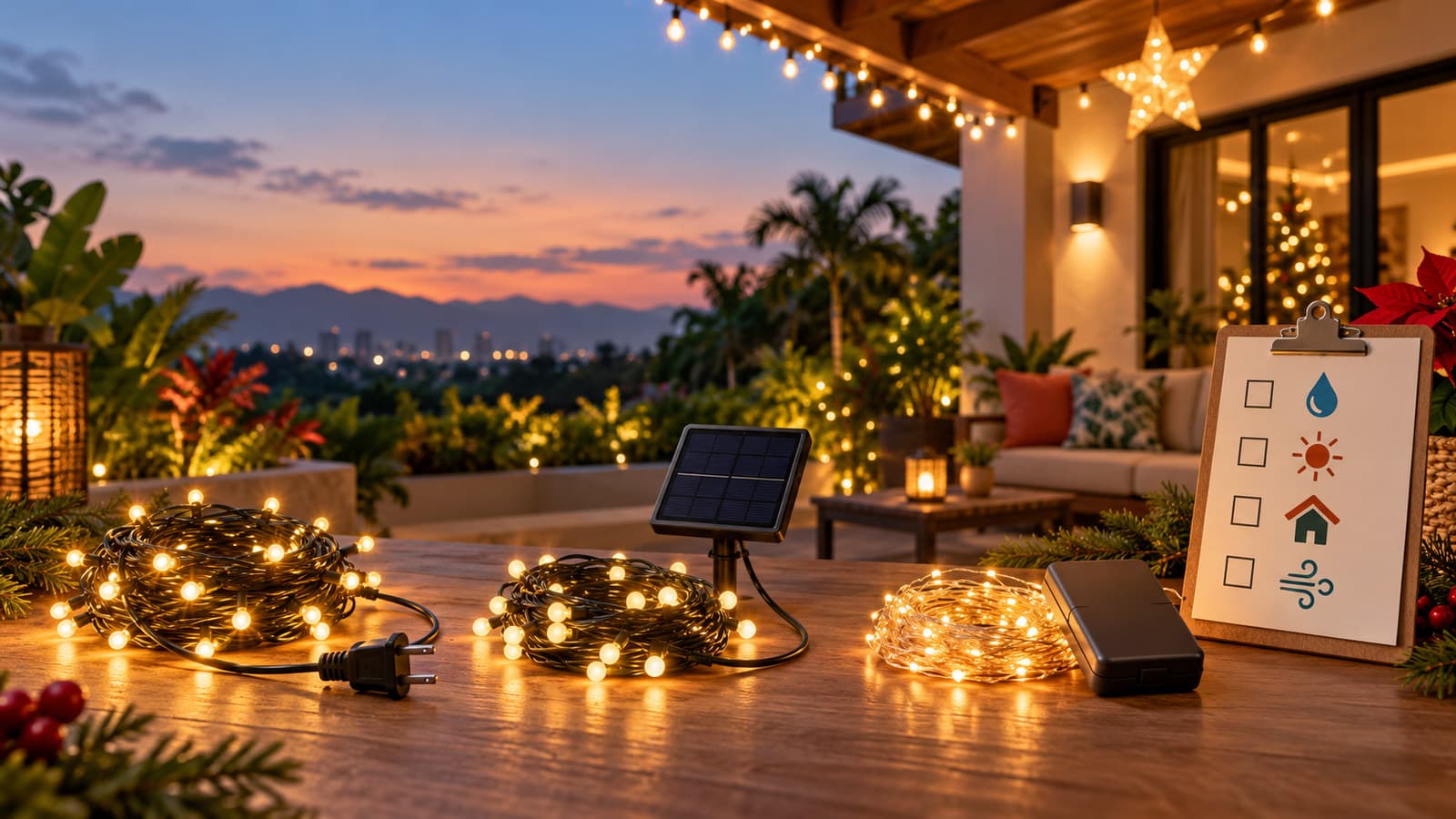
Christmas Lights Buying Guide PH: Plug-In, Solar or Battery?
About this guide
The SulitScan editorial team prepares buyer guides using desk-researched product information, primary guidance where available, and practical pre-purchase checks. We do not claim hands-on testing unless an article explicitly says a product was tested.
In this guide
- How we assessed this guide
- Read the DTI-BPS scope before interpreting a mark
- Map the installation before choosing a power source
- Plug-in sets: verify the whole connection
- Solar sets: check the panel location and operating plan
- Battery sets: compare maintenance, not just convenience
- Compare the useful set, not the promotional photograph
- Worked Christmas-light decision
- Christmas-lights checkout checklist
- Limitations and live-policy check
- Affiliate disclosure
Choose Christmas lights by the installation location, documented electrical requirements, and power source: plug-in when a suitable connection is available, solar when the exact model's panel placement and charging instructions suit the site, or battery when replacing or recharging cells is practical. Then check the applicable Philippine certification scope for the exact design. “Outdoor,” “LED,” “solar,” or a decorative badge alone does not prove safety, PS/ICC coverage, or the ability to run through the night.
How we assessed this guide
This is desk research based on the DTI-BPS mandatory-certification product list, its Christmas lights and lighting chains scope table, and a model-specific IKEA GETKÅL battery lighting chain, article 406.092.94.
We also consulted DTI-BPS's December 1, 2021 Christmas-light reminder. That 2021 publication is historical safety guidance, not evidence of a 2026 campaign or a current certified-product list. Its reminder to examine PS/ICC information must be read with today's exact product scope, not used to erase listed exclusions.
SulitScan did not energize, inspect, certify, or weather-test any light set. The guide separates the official scope question from practical installation and operating questions that still require the manufacturer's current instructions.
Read the DTI-BPS scope before interpreting a mark
The current scope table covers sets using push-in or filament lamps and LED types intended for indoor use or marked for indoor/outdoor use. It separately lists designs that are not covered: lighting integral to Christmas trees, lanterns, or decorations; outdoor-designed sets; rope lights; D.C.-supply sets; neon lights; meteor tubes; sets with a power-supply adapter; and General Lighting Services (GLS) sets.
These exclusions do not mean an item is safe. They also do not justify saying every solar, battery, outdoor, rope, or adapter-powered set is PS/ICC-covered. Do not collapse “marked indoor/outdoor” into the separately excluded outdoor-designed category, or assume the power-source label alone settles classification.
For a particular purchase, use the current DTI-BPS route and ask for clarification if the design is ambiguous. The seller should identify the exact product, applicable evidence, and instructions. A mark shown in a generic listing photo does not establish that the item being dispatched matches it. The electrical-safety guide explains why identity and evidence need to match.
Map the installation before choosing a power source
Sketch where the lights, power connection, panel, or battery box will sit. Include the route between them, the attachment points, and the space people will walk through. Measure the illuminated section separately from the lead cable; the advertised total length may not describe the decorated length you expect.
Record the conditions at each component, not only at the lights. An eave might shelter the bulbs while the controller or connection sits somewhere exposed. Look for instructions that explicitly cover the intended placement of every part. If the listing supplies only a scenic photo, that is not enough to plan the installation.
For rented homes, check whether the mounting method is allowed and can be removed without damage. Consider how you will reach the switch, inspect the set, replace batteries, and take everything down. A display that is awkward to maintain can be the wrong purchase even when its length fits.
Plug-in sets: verify the whole connection
For a plug-in candidate, check the exact rated input and supplied plug, controller, and adapter if present. Do not infer compatibility from the fact that a marketplace serves Philippine addresses. Ask for readable rating and instruction information for the selected variant.
Confirm whether multiple sets may be connected and the manufacturer's stated limits. Do not join sets because their connectors appear to fit. The design, electrical limits, and instructions must permit the arrangement. If the planned connection needs electrical alterations or you are unsure about the supply, get qualified help rather than improvising.
A timer or smart plug is another component with its own compatibility and placement requirements. Include it in the comparison only if the full arrangement is supported. A scheduling feature does not certify a light set or make an unsuitable connection acceptable.
Solar sets: check the panel location and operating plan
A solar set moves part of the decision to the panel. Check where the maker says it should be positioned, how charging and switching work, and whether the panel cable reaches the intended location. A shaded balcony and an open garden present different planning questions; no generic runtime claim can settle the result for both.
Ask whether the battery is replaceable, which replacement is permitted, and where instructions can be found. If the model's operating information is vague, do not assume it will provide a set number of hours each evening. Plan an alternative if consistent light at a specific time matters.
Solar is a power-source description, not a safety certificate. Check the complete product's applicable requirements and installation instructions. Do not infer PS/ICC coverage merely from an LED or solar keyword, and do not infer that an excluded design requires no further care.
Battery sets: compare maintenance, not just convenience
Battery-powered lights can avoid the need to run a mains lead to the display, but they introduce a replacement or charging routine. Record the required battery type, count, whether cells are supplied, and any permitted rechargeable alternative. Include those items in the delivered-cost comparison.
For the exact GETKÅL 406.092.94 reference, IKEA describes indoor and outdoor use and a timer that operates for six hours. Its page says batteries are sold separately, specifies three cells, recommends its stated LADDA rechargeable type, and warns against mixing old and new batteries, brands, or types. Those details do not describe other GETKÅL variants or every battery light.
A six-hour timer setting is not evidence of six hours of equal brightness in every condition or a promise of battery life. Follow the model's instructions and check access to the battery box before installation. If the display requires frequent maintenance in a hard-to-reach position, reconsider the placement.
Compare the useful set, not the promotional photograph
List the lit length, lead length, number of sets required, mounting accessories, power components, and batteries where applicable. Then compare the current final cart totals. A lower sticker price may exclude a component needed to use the product as intended.
Look for the same variant in customer evidence. A review of a short indoor string does not verify a longer outdoor-advertised option on the same listing. Use our product review checklist to separate aesthetic feedback from evidence about packaging, identity, and instructions.
The home category and Shopee PH store guide offer onward research, not an active matching product or availability claim. Confirm delivery and the issue-reporting window before ordering for a fixed event date.
Worked Christmas-light decision
Suppose the goal is a small sheltered patio display. One plug-in set has unclear controller-placement instructions, one solar set lacks a usable panel location, and one battery set states the intended placement and battery requirements clearly. The battery option may deserve further review, but it has not automatically become a verified safe recommendation.
First, resolve the product's exact design and DTI-BPS scope. Next, match every component to the site and read the installation directions. Finally, compare complete costs and maintenance access. If a required detail remains missing, choose another documented product or postpone the display.
The decision might change for a large indoor tree, a balcony without shelter, or a location that must be lit reliably at a fixed hour. Do not reuse a recommendation from a different setting without repeating those checks.
Christmas-lights checkout checklist
- Map the location of lights, controller, connection, panel, or battery box.
- Separate lit length from lead length and check mounting access.
- Match the exact design to current DTI-BPS scope and evidence.
- Remember that listed exclusions do not establish safety.
- Verify ratings, component compatibility, and permitted connections.
- Read the exact indoor/outdoor placement and operating instructions.
- Include required batteries and accessories in the current cart total.
- Inspect the delivered set before use and stop when damage or missing instructions create uncertainty.
Limitations and live-policy check
This October 3 collection guide was rechecked during release preparation. Certification scope, product revisions, instructions, stock, and seller policies may change. The official scope page and exact model documentation are the next checks, not a generic category label or an old list.
SulitScan cannot assess your wiring, installation, weather exposure, or delivered unit. We do not guarantee electrical safety, waterproofing, brightness, runtime, or service life. Seek qualified guidance when the installation or applicable requirement is unclear.
Affiliate disclosure
SulitScan may earn a commission from eligible store links at no extra cost to you. Affiliate relationships do not influence this assessment. The source examples are included for their documented scope or specifications, not to imply certification by SulitScan. Our affiliate disclosure explains the relationship.
Frequently asked questions
Are all solar and battery Christmas lights PS/ICC-covered?
No. Check the exact design against the current DTI-BPS scope. The table excludes several designs, including D.C.-supply sets, and exclusion does not establish that a product is safe.
Does an outdoor label mean every component can be exposed?
Do not assume it does. Read the exact instructions for the lights, controller, connectors, panel, and battery box, and match each component's permitted placement to the planned site.
Does the 2021 DTI-BPS reminder verify a current light set?
No. It is historical safety guidance, not a 2026 certification or current-product list. Use current official scope and verification information for the exact product being purchased.
Tags
Get weekly sulit finds in your inbox
Shopping tips, price-check reminders, and the best deals, free.
More shopping guides


Explore SulitScan