Insulated Tumbler Buying Guide Philippines: Size, Lid, Care
About this guide
The SulitScan editorial team prepares buyer guides using desk-researched product information, primary guidance where available, and practical pre-purchase checks. We do not claim hands-on testing unless an article explicitly says a product was tested.
In this guide
- How we assessed this guide
- Start with capacity, dimensions, and how you carry it
- Treat the lid as a use-case decision
- Verify materials and insulation without borrowing claims
- Plan cleaning before the first drink
- Worked tumbler fit decision
- Insulated tumbler checkout checklist
- Limitations and live-policy check
- Affiliate disclosure
Choose an insulated tumbler by practical fit before brand language: usable capacity, overall height, base diameter, grip or handle, exact lid design, spill risk, and whether every seal can be cleaned. Treat “vacuum insulated,” “leakproof,” steel grade, dishwasher safety, and time-based temperature retention as exact-model claims that need evidence, not promises carried by the word tumbler.
How we assessed this guide
On 2026-09-05, we reviewed the Philippine FDA Citizen's Charter entry for food-contact suitability evaluation. It describes a technical service for manufacturers or distributors. It is not a generic consumer approval badge, so this guide does not turn the agency name into a shortcut for product quality.
We also reviewed two manufacturer pages as examples of what exact-model evidence can look like. A Stanley model page publishes construction, lid, removable-part, dimension, capacity, and care information for that named model. A Hydro Flask product page illustrates model-specific cleaning, microwave, and cleanser limitations. We do not transfer either page's claims to another container.
SulitScan did not fill, leak-test, measure, wash, or authenticate any tumbler. This is an evidence and fit workflow. The online product review checklist can help compare repeated exact-variation reports with the seller's claims.
Start with capacity, dimensions, and how you carry it
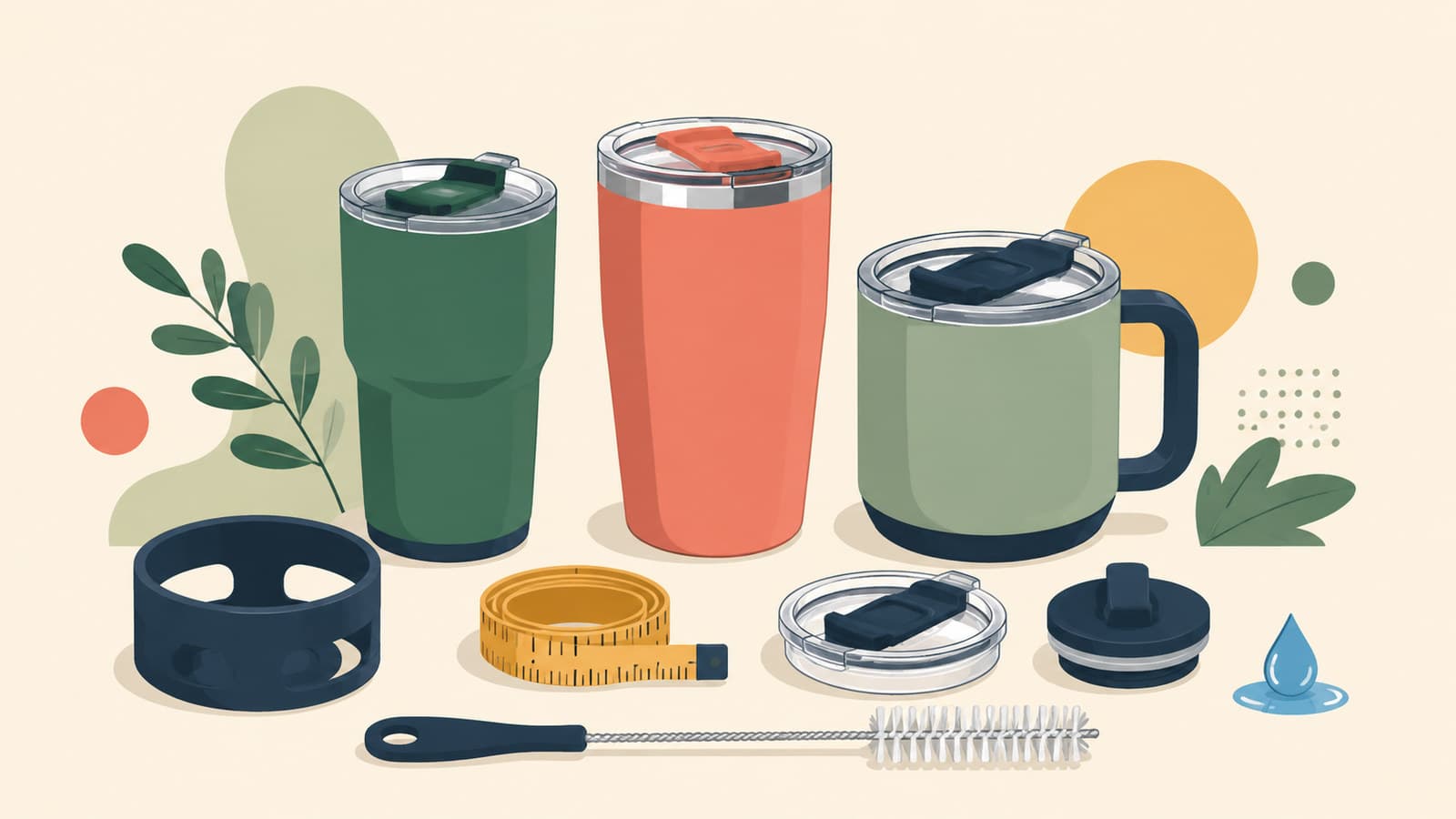
Nominal capacity is only useful when the container fits the place and routine. Measure the cup holder's narrowest usable diameter and depth, the cabinet or bag height, and clearance for a handle. Compare those measurements with the product's overall height, widest point, and base diameter. Do not infer base fit from a tapered photo.
Think about fill weight as well as empty weight. A large tumbler may be inconvenient when full, hard to grip, or top-heavy in a shallow holder. A handle can help but may block adjacent cup holders or bag pockets. For a commute, a shorter sealed bottle may be a better format than an open-straw tumbler even when both hold a similar amount.
Use home finds, under-500 browsing, Shopee PH, or Temu to discover shapes. These routes do not establish current stock or fit; measure and verify the live exact model before ordering.
Treat the lid as a use-case decision
A straw opening favors easy sipping but creates a path through the lid. A sliding cover can reduce splashes without necessarily sealing against inversion. A threaded or latched closure may be more appropriate for a bag, but only an exact-model claim and suitable evidence can support leak resistance.
Ask what “leakproof” means on the page: upright splash resistance, a closed straw position, or transport in any orientation. Check whether the claim applies to hot liquids, cold liquids, carbonated drinks, or only a defined setup. A product photo shown on its side is not a test report.
Inspect removable seals, straw valves, sliders, hinges, and replacement-part availability. More pieces can improve closure yet add cleaning work and loss risk. If the seller cannot show how the lid disassembles, assume cleaning access is unresolved.
Verify materials and insulation without borrowing claims
Look for the exact body, inner wall, lid, straw, gasket, and coating materials. “Stainless steel” without a grade, source, or exact-model document is less informative than a complete specification. Even a stated steel grade does not establish lid material, coating durability, or manufacturing quality.
Vacuum insulation describes construction; retention depends on the full product, starting temperature, fill amount, ambient conditions, lid position, and test method. Compare hour-based hot or cold claims only when the exact model and conditions are stated. Do not borrow a famous model's retention claim for a similar-looking listing.
Avoid describing a tumbler as agency-approved based on a generic claim. The Philippine FDA service reviewed concerns food-contact suitability evaluation for responsible businesses. Ask the seller for specific material and compliance evidence, then evaluate what that evidence actually covers. It does not replace inspection, care, or exact usage limits.
Plan cleaning before the first drink
Map every surface the drink touches: vessel, underside of lid, straw, gasket groove, slider, valve, and threads. Confirm which parts detach, whether a narrow brush is required, and whether replacements exist. A part described as dishwasher safe may have rack-position or temperature conditions; read the exact instructions.
Wash before use according to the manufacturer instructions. Do not use a microwave, freezer, bleach, abrasive cleanser, or high heat unless the exact model directions allow it. Different models have different restrictions, which is why the Hydro Flask care example cannot be generalized.
For hygiene-sensitive returns, do not assume that a used drink container remains eligible after filling or washing. Inspect the delivered variation, finish, damage, lid pieces, and documentation before first use, preserve packaging, and read the live seller or platform condition rules. A cleanable design reduces routine risk but does not guarantee odor-free or stain-free use.
Worked tumbler fit decision
Suppose a buyer wants one tumbler for a car commute and a work desk, and is comparing a tall straw model with a shorter handled model.
- Measure the vehicle holder's base diameter and depth, the desk clearance, and the bag compartment if the tumbler will travel there.
- Choose the spill scenario. An upright desk may tolerate a straw opening; a bag usually calls for a stronger exact-model closure claim.
- Compare usable capacity, full dimensions, empty weight, handle clearance, lid parts, seal removal, replacement parts, and care instructions.
- Require exact-model support for material, dishwasher, leak, and retention claims. Mark any ambiguous specification unknown rather than borrowing evidence.
- Select the container that clears fit, spill, and cleaning requirements. If neither has a lid appropriate for transport, use a different format.
SulitScan pages for a 40oz insulated tumbler and a double-wall tumbler can serve as comparison prompts. Recheck the live product page, dimensions, selected variation, seller, instructions, and checkout; the links are not a guarantee of availability or performance.
Insulated tumbler checkout checklist
- Pick the intended drink, serving size, and hot-or-cold use.
- Measure base diameter, height clearance, bag position, and handle space.
- Choose a lid for upright sipping or sealed transport; do not confuse the two.
- Confirm every body, lid, straw, gasket, and coating material claimed.
- Require exact-model evidence for insulation, retention, leak, and dishwasher claims.
- Check lid disassembly, gasket access, brush needs, drying, and replacement parts.
- Read use limits for heat, carbonation, microwave, freezer, and cleansers.
- Review exact-variation reports for spill, finish, odor, and cleaning patterns.
- Inspect before use and read live hygiene-sensitive return conditions.
- Compare the final order only after model, variation, and seller all match.
The fake discount guide is useful when a dramatic crossed-out amount distracts from fit. A poor-fitting tumbler does not become better because a discount looks large.
Limitations and live-policy check
This guide was reviewed on 2026-09-05. Product construction, certification evidence, dimensions, replacement parts, care instructions, seller listings, and platform return rules can change. Use the exact model's current manufacturer instructions and the live product, seller, and checkout pages.
SulitScan cannot verify food-contact materials, vacuum integrity, temperature retention, seal performance, or hygiene for a particular item. Seller documents and reviews are evidence inputs, not guarantees.
Affiliate disclosure
SulitScan may earn a commission when a reader follows an eligible partner link and completes a purchase, at no extra cost to the reader. SulitScan does not sell, test, certify, authenticate, or guarantee the products or outcomes. Affiliate status does not establish agency approval, leak resistance, or suitability for a reader's routine. See the full Affiliate Disclosure.
Frequently asked questions
Is a straw tumbler automatically leakproof?
No. A straw opening is a path through the lid. Check the exact model's closure design, intended orientation, stated conditions, and evidence instead of assuming sealed transport.
Does the Philippine FDA approve individual tumblers?
Do not infer product approval from a generic agency claim. The reviewed FDA service is a food-contact suitability evaluation route for manufacturers or distributors; assess exact evidence and what it covers.
Can every insulated tumbler go in a dishwasher?
No. Dishwasher, rack, heat, cleanser, and disassembly instructions are model-specific. Follow the exact manufacturer's current care directions.
Tags
Get weekly sulit finds in your inbox
Shopping tips, price-check reminders, and the best deals, free.
More shopping guides

Explore SulitScan