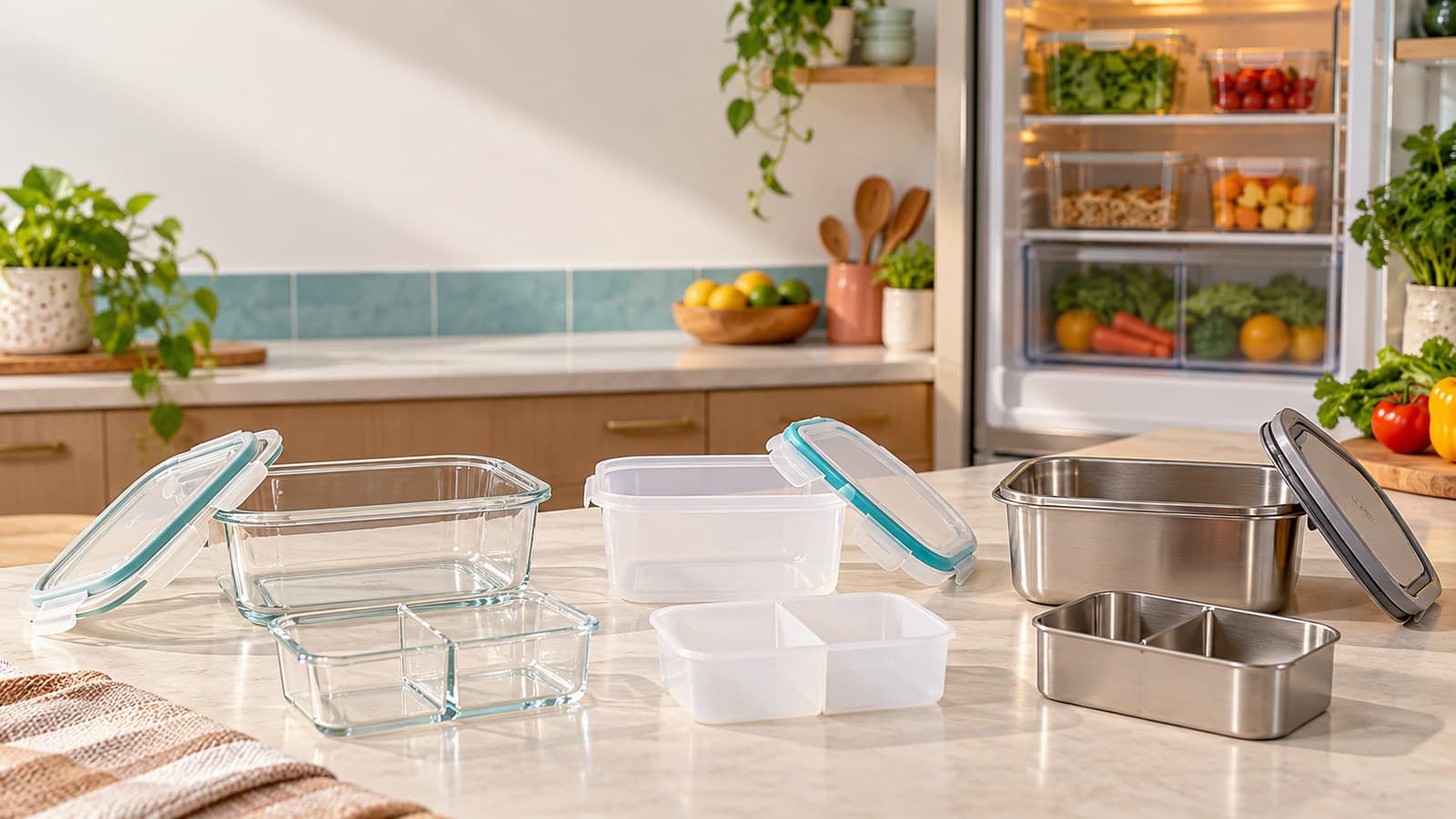
Food Storage Containers Philippines: Glass, Plastic or Stainless?
About this guide
The SulitScan editorial team prepares buyer guides using desk-researched product information, primary guidance where available, and practical pre-purchase checks. We do not claim hands-on testing unless an article explicitly says a product was tested.
In this guide
- How we assessed this guide
- Start with portions and shelf space
- Compare glass, plastic, and stainless by workflow
- Treat the lid and seal as separate components
- Plan cooling, reheating, and washing before buying
- Compare cross-border landed cost
- Worked container decision
- Food-container checkout checklist
- Limitations and live-policy check
- Affiliate disclosure
Choose food storage containers by the job they must do: glass for a compatible reheating workflow, plastic when carrying weight matters, or stainless when you can transfer food to a suitable reheating dish. No material name alone proves microwave suitability, leak resistance, or food safety. For Philippine buyers, the useful comparison is the exact body, lid, portion size, care instructions, delivered cost, and replacement options—not the largest advertised set.
How we assessed this guide
This is desk research, not a hands-on container test. We compared everyday storage decisions with the United States FDA's microwave guidance and the United States USDA's leftovers and food safety guidance. These are US sources, not Philippine certification or approval of a seller's container.
The FDA advises following oven instructions and using microwave-suitable cookware; some plastics are unsuitable, and metal generally should not go into a microwave. USDA recommends dividing large quantities into shallow containers for rapid cooling and promptly refrigerating leftovers. These points explain why the intended use and container shape matter. They do not establish that any unnamed marketplace product meets a particular standard.
Our comparison method is to eliminate candidates whose instructions conflict with your workflow, then compare the useful pieces that remain. We did not verify a particular listing, conduct migration or leak tests, or measure cooling performance.
Start with portions and shelf space
List the meals you actually store during a normal week. A lunch portion, a batch of soup, chopped ingredients, and a dry snack do not necessarily need the same depth or closure. Count the containers that will be occupied at once, including any waiting to be washed. This is more useful than choosing a set because its photographed stack looks generous.
Measure the usable shelf depth and height, including the space needed to lift a container out. Record the outer dimensions with the lid attached, not only the internal capacity. A wide latch or overhanging rim can turn an apparently good fit into wasted shelf space. For stacking, ask whether lids lock into position or merely rest on one another.
Check the piece count. A ten-piece set may mean five boxes and five lids. Dividers, tiny sauce cups, and lids can all inflate the headline count without adding five usable meal portions. Write down the number and capacity of complete container-and-lid pairs.
Compare glass, plastic, and stainless by workflow
For a glass candidate, ask for the exact oven, microwave, freezer, and temperature-change instructions. Do not turn a glass-body claim into permission to heat the lid. Check the loaded carrying weight and whether your commute provides a protected place for the container. A clear body may be convenient for identifying leftovers, but that convenience does not establish heat tolerance.
For a plastic candidate, ask whether repeated use and your intended reheating method are explicitly supported. Record the body and lid material information separately. A broad material slogan does not supply a usable temperature limit or wash instruction. If you cannot find those details, compare a different listing rather than guessing from a recycling symbol or product photograph.
For a stainless candidate, plan where food will be transferred when microwave reheating is required. Compare whether that extra dish and washing step are acceptable. A stainless body still needs a suitable closure and clear care directions. Do not assume that an insulated-looking shape keeps a meal at an appropriate temperature throughout a working day.
There is no universal winning material here. A container that serves your one repeated task can be a better purchase than a versatile-looking bundle with undocumented limitations.
Treat the lid and seal as separate components
Ask whether the closure is intended for upright refrigerator storage, transport, or both. “Airtight” and “leakproof” are seller claims to investigate, not interchangeable proof. Look for instructions on assembling the lid, seating the seal, removing gaskets for cleaning, and replacing worn components.
Consider who opens it. A latch that looks secure online may be awkward for a child, an older relative, or someone with limited hand strength. If that matters, an in-person demonstration or clear return route may be more valuable than a small checkout reduction.
Use our product review checklist to find reports about the exact size and closure. Separate a reviewer's experience with water transport from a photo of an empty box. Neither proves that every unit will seal, and a high overall rating can combine unrelated variants.
Plan cooling, reheating, and washing before buying
For cooked leftovers, the USDA guidance makes shallow portions and prompt refrigeration more relevant than buying one very deep family tub. A closed lid does not make unsafe storage conditions safe. Consult the complete linked guidance for time and temperature handling; this article is a shopping checklist, not a complete food-safety protocol.
Write a short routine: portion, store, transport if needed, reheat using a supported method, and wash according to the exact component instructions. At each step, ask whether the body and lid have different requirements. If the seller cannot explain whether a seal is removable or a lid can enter the dishwasher, treat that as missing evidence.
Think about drying space too. Five boxes with separate lids and seals may occupy more of a small kitchen than the nesting photograph suggests. Start with fewer useful sizes if storage and washing capacity are limited. Replacement lids can be worth checking before buying a large matching collection.
Compare cross-border landed cost
Imported checkout totals can differ from the shelf-like price in a search result. Compare the exact quantity and size, delivery charge, any fees or taxes already collected, currency conversion where relevant, and any additional charges the seller or carrier identifies. Do not add an estimated charge a second time if checkout already includes it.
Use ImportTaxPH, our sister tool, to organize an estimated landed-cost comparison when buying cross-border. Its output is an estimate, not a Bureau of Customs assessment or a promise that a parcel will be exempt. Confirm the current classification and collection details with the responsible official or carrier source when necessary.
Then compare that estimated total with a locally delivered alternative of equivalent usable capacity. Include replacement-lid availability and the practical cost of returning a bulky or fragile order. The checkout comparison tool can help organize the cart arithmetic; it does not verify seller claims or import treatment.
Worked container decision
Imagine a buyer who prepares lunch at home, walks to work, and uses an office microwave. The first shortlist contains a glass meal box, a light plastic set, and a stainless lunch box. The buyer should not rank these by the photographed piece count.
First, establish the needed portion and the lunch-bag dimensions. Next, eliminate any candidate without clear food-contact use and care information. For microwave use, verify the exact supported components; the stainless option needs a separate compatible dish. Finally, compare the loaded weight, closure instructions, useful quantity, and delivered total.
If the light set contains mostly tiny tubs, it may not solve the lunch problem. If the glass option is cumbersome to carry, its reheating convenience may not compensate. If transferring food is easy at work, stainless remains a candidate. This is a decision framework, not a tested ranking or a recommendation of a particular unit.
Food-container checkout checklist
- Count complete container-and-lid pairs rather than advertised pieces.
- Match capacity and external dimensions to portions, shelves, and bags.
- Verify the body, lid, seal, and intended food-contact use separately.
- Read exact microwave, freezer, oven, and wash restrictions.
- Confirm the closure's intended use and replacement-part route.
- Compare current delivered totals for equivalent useful quantities.
- Preserve the selected variant, instructions, and seller information.
- Inspect the delivered item before food use and follow the live issue-reporting process.
Our home guides category and Temu store guide are browsing and checkout resources, not an active matching product claim. Use them to continue research, then verify the chosen retailer's current details.
Limitations and live-policy check
This October 3 release guide uses public information and was rechecked during release preparation. Listings, instructions, shipping charges, stock, and return conditions can change. Current manufacturer instructions and the exact seller's checkout terms take precedence over a general comparison.
SulitScan cannot determine chemical suitability, inspect your kitchen, validate a seal, or promise leak resistance or safe food handling. Stop a purchase when a critical specification remains unanswered. Keep the receipt and packaging, and ask the seller about faults through its current support route.
Affiliate disclosure
SulitScan may earn a commission through eligible store links at no extra cost to you. Affiliate relationships do not influence this assessment. The official references explain specific evidence; they are not endorsements of SulitScan or its partner stores. Read our affiliate disclosure for how those relationships work.
Frequently asked questions
Is glass always better than plastic for food storage?
No. Compare the exact container's intended use, carrying weight, dimensions, lid, and care instructions. A material name does not establish microwave suitability or leak resistance.
Can a stainless container go in the microwave?
US FDA guidance generally advises against metal in a microwave. Follow the exact oven and container instructions and plan to transfer food to a suitable dish when required.
How should I compare an imported container set?
Compare complete usable container-and-lid pairs, dimensions, delivered cost, any identified additional charges, and the return route. An import-cost estimate is not an official customs assessment.
Tags
Get weekly sulit finds in your inbox
Shopping tips, price-check reminders, and the best deals, free.
More shopping guides

Explore SulitScan