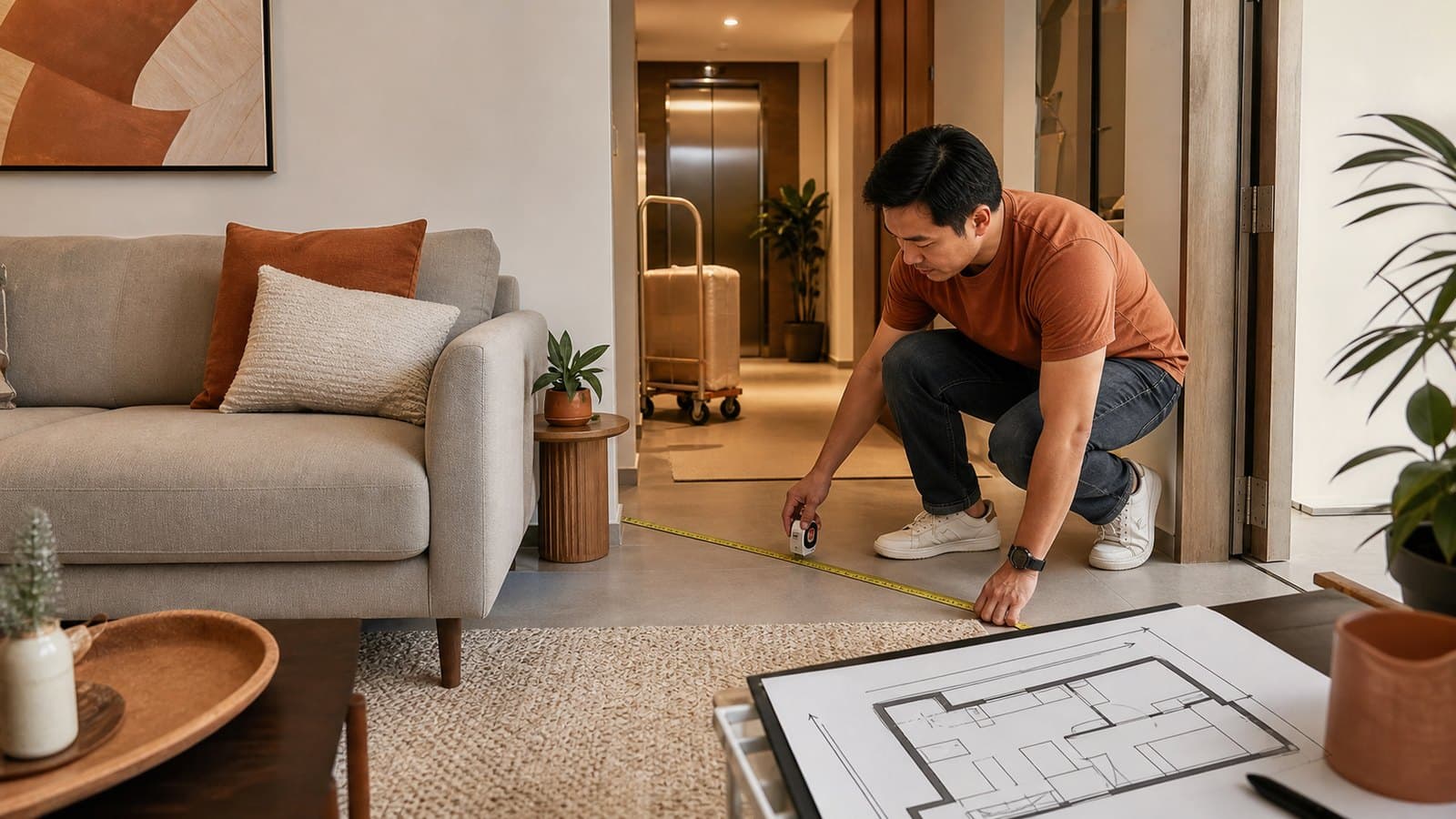
Online Furniture Measurement Guide for Filipino Buyers
About this guide
The SulitScan editorial team prepares buyer guides using desk-researched product information, primary guidance where available, and practical pre-purchase checks. We do not claim hands-on testing unless an article explicitly says a product was tested.
In this guide
- How we assessed this guide
- Record the product in all useful orientations
- Measure the final room and operating clearance
- Trace the complete delivery route
- Compare packaged and assembled dimensions
- Check scale, load, and material evidence
- Plan delivery, assembly, and damage evidence
- Furniture fit worksheet
- Final pre-order checklist
- Affiliate disclosure
Furniture can fit the room on paper and still fail at the doorway, stair landing, elevator, or final turn. Online listings often emphasize width, height, and depth, but buyers also need packaging size, assembled orientation, leg or back removal options, working clearance, and a complete delivery path.
This guide turns those checks into a simple measurement worksheet for sofas, desks, cabinets, shelves, bed frames, chairs, and storage furniture ordered online in the Philippines.
How we assessed this guide
The measurement workflow is based on practical fit and delivery geometry, then paired with the DTI-BPS e-commerce guidance that online product descriptions, delivery options, tracking, and post-purchase policies should be clear enough to support informed decisions: DTI-BPS e-commerce transaction guidelines.
SulitScan does not measure a seller's product, room, building, elevator, or delivery vehicle. Always confirm measurements for the exact variant and ask the seller or courier how the item is packaged and handled.
Record the product in all useful orientations
Start with the listing's assembled width, depth, and height. Then identify which dimension can become vertical while the item is carried. A sofa may pass through a door on its end if the arm, back, and packaging allow it. A rigid cabinet may not.
Request these measurements when the listing does not show them:
- Fully assembled width, depth, and height
- Packaged carton dimensions and weight
- Largest rigid component if the item arrives flat-packed
- Diagonal depth or corner-to-corner dimension for bulky upholstery
- Removable legs, arms, backs, doors, shelves, or drawers
- Space needed to assemble, open doors, extend recliners, or pull out drawers
Do not assume the product title is a measurement. “Two-seater,” “queen,” “compact,” and “20-inch” can describe a category rather than the exact external size.
Measure the final room and operating clearance
Draw a simple top-down room plan. Mark wall-to-wall dimensions, columns, baseboards, doors, windows, outlets, switches, vents, curtains, and fixed appliances. Record the space that must remain usable, not just the empty rectangle where the furniture will sit.
Examples of working clearance include:
- Space behind a chair so it can slide out
- Door swing in front of a cabinet
- Drawer or recliner extension
- Walking path between a bed and wall
- Ventilation around an appliance or electronics cabinet
- Curtain movement and window access
- Access to outlets, breakers, valves, or cleaning areas
Use painter's tape, newspapers, or cardboard to mark the footprint on the floor. Live with the outline for a day if the item is large. Check whether normal walking, cleaning, opening, and sitting still work.
Trace the complete delivery route
Measure from the unloading point to the final room. The narrowest or sharpest part decides whether the item can pass.
Record:
- Building entrance and gate width and height
- Hallway width, low ceilings, lights, railings, and corners
- Every doorway's clear opening with the door open
- Stair width, ceiling height, landing size, and turn angle
- Elevator door opening, cabin width, depth, height, and rated load
- The final room doorway and the turning space on both sides
Measure the clear opening, not the frame's outside dimension. Door handles, closers, railings, and elevator control panels reduce usable space. Ask building management about delivery schedules, service-elevator rules, loading bays, deposits, and protective requirements before confirming a large order.
Compare packaged and assembled dimensions
A flat-packed desk may be easy to deliver but require a large clean floor area for assembly. A fully assembled sofa may have a smaller listed footprint than its protective carton. Ask whether delivery staff remove packaging outside, assemble indoors, carry upstairs, or stop at the ground floor.
For modular furniture, confirm the size of the largest module and how pieces connect. For cabinets and shelving, check whether the item must be assembled upright. A tall unit assembled flat may need extra ceiling clearance when it is tilted into position.
Keep a safety margin rather than ordering an item that theoretically clears by a few millimeters. Packaging can bulge, walls can be uneven, and online dimensions may be rounded.
Check scale, load, and material evidence
Photos can make furniture look larger or smaller than it is. Compare listed dimensions with a familiar object and use the tape outline, not the styled room image, to judge scale.
For shelves, tables, and seating, ask for the seller's stated load limit and assembly instructions. Check buyer photos for joint design, fasteners, back panels, edge finishing, and leg attachment. A product review saying “large” or “sturdy” is less useful than a measured photo or description of real use.
If a sofa cover, organizer, or accessory must fit existing furniture, measure the actual contact area and shape. The related deals below are starting points only; confirm every dimension and material on the partner store.
Plan delivery, assembly, and damage evidence
Save the listing dimensions, selected variant, delivery promise, assembly scope, and return terms before checkout. Confirm who is responsible if the package cannot pass a route the seller was told about, or if the item arrives damaged.
Clear the path, protect floors and walls, secure pets, and keep the measurement sheet available on delivery day. Inspect the outer packaging before moving it far. Photograph crushed corners, punctures, water exposure, or missing cartons. Our unboxing evidence guide explains how to preserve useful evidence under the platform's current rules.
Do not discard packaging or assemble a damaged item until you understand the return instructions. Some sellers require original cartons, and assembly can complicate a claim.
Furniture fit worksheet
- Product assembled size: width ___ depth ___ height ___
- Package size and weight: ___
- Largest rigid component: ___
- Removable parts: ___
- Final room footprint and clearance: ___
- Narrowest door opening: ___
- Tightest hallway or stair turn: ___
- Elevator opening and cabin: ___
- Assembly floor and ceiling clearance: ___
- Delivery service level and building rules: ___
- Return window and packaging requirement: ___
If you are furnishing a new place, pair the measurement sheet with our first apartment essentials guide so small practical needs are prioritized before decorative purchases.
Final pre-order checklist
- I measured the exact product variant and its package.
- I marked the final footprint and operating clearances.
- I traced every door, hall, stair, elevator, and turn.
- I know which parts are removable and who assembles the item.
- I checked building delivery rules and service access.
- I saved dimensions, seller answers, delivery scope, and return terms.
- I left a realistic margin instead of relying on a perfect theoretical fit.
Affiliate disclosure
SulitScan may earn a commission when you click an eligible partner link and complete a purchase, at no extra cost to you. We do not measure, deliver, assemble, load-test, or guarantee listed furniture. Dimensions, packaging, building access, delivery scope, prices, and return terms can change. Confirm every detail with the seller, courier, and building before ordering. See our full Affiliate Disclosure.
Frequently asked questions
Which furniture measurement matters most for delivery?
The limiting point is the narrowest opening or tightest turn along the full delivery route, compared with the packaged item or largest rigid component in a workable orientation.
How much extra clearance should I leave?
There is no universal margin, but do not rely on a few millimeters. Listings may round dimensions, packaging can bulge, and real walls or frames may be uneven.
Should I measure the package or the assembled furniture?
Both. Package dimensions determine delivery fit, while assembled dimensions and operating clearances determine whether the item works in the room.
Tags
Get weekly sulit finds in your inbox
Shopping tips, price-check reminders, and the best deals, free.
More shopping guides
Explore SulitScan