Wireless Earbuds Buying Guide Philippines: Fit, Calls, Battery
About this guide
The SulitScan editorial team prepares buyer guides using desk-researched product information, primary guidance where available, and practical pre-purchase checks. We do not claim hands-on testing unless an article explicitly says a product was tested.
In this guide
- How we assessed this guide
- Choose fit before sound-feature labels
- Match the exact phone, codec, app, and controls
- Evaluate calls, battery, and the charging case separately
- Verify NTC evidence and warranty by exact model
- Build safer listening into the purchase
- Worked wireless-earbuds pre-check
- Wireless earbuds checkout checklist
- Limitations and live-policy check
- Affiliate disclosure
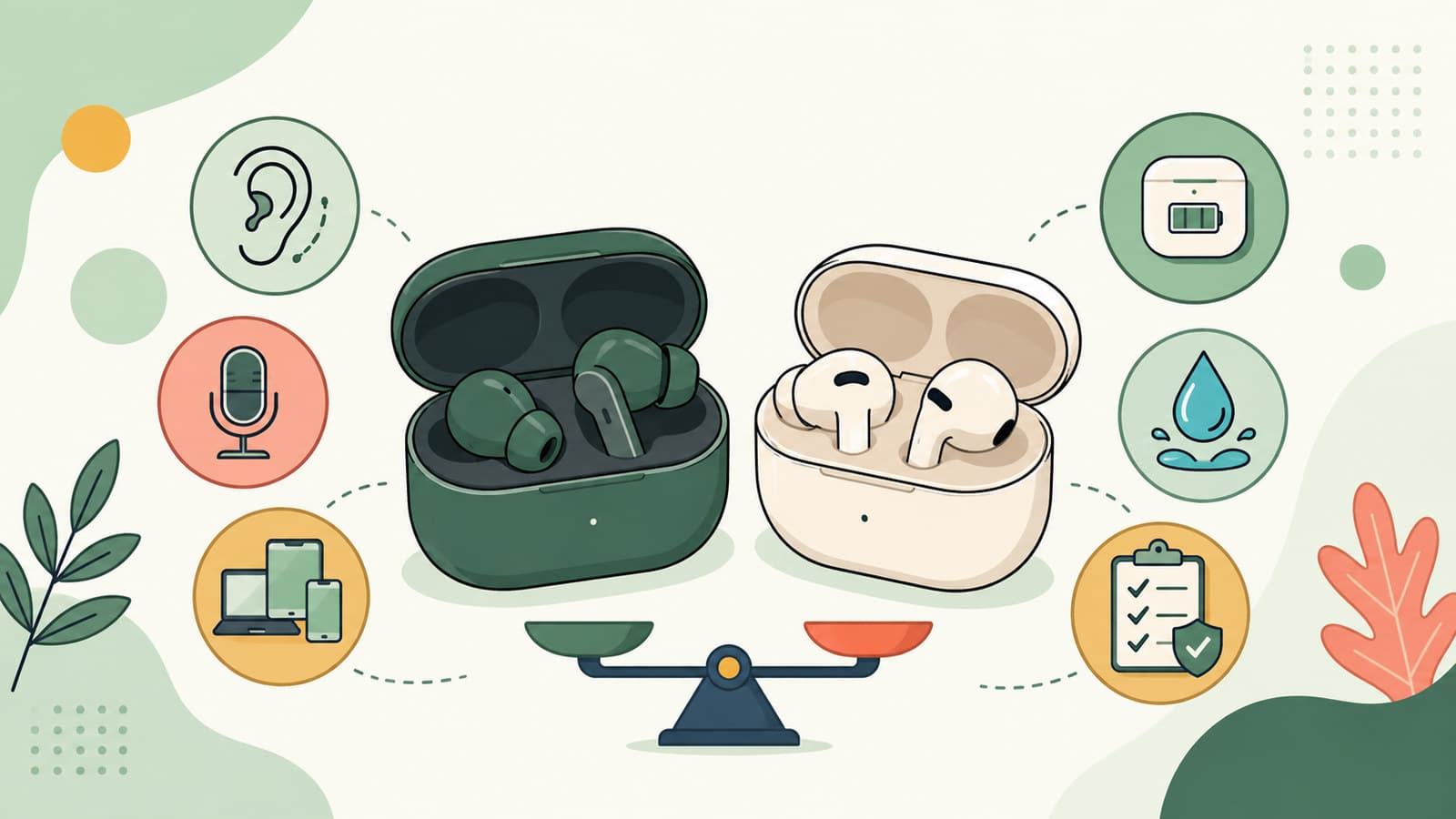
Choose wireless earbuds by fit and phone compatibility before chasing feature labels. Confirm ear-tip or open-fit options, controls, codec and app support, microphone evidence, charging connector and case size, exact-model battery conditions, NTC record evidence, warranty, and current hygiene-sensitive return terms. Bluetooth version alone cannot guarantee sound, latency, runtime, or compatibility.
How we assessed this guide
On 2026-09-05, we reviewed the NTC Region 7 frequently asked questions. It says commercial radio-communications equipment needs the applicable type approval or acceptance and points readers to NTC records. We therefore ask for an exact make-and-model match instead of treating a generic NTC logo or seller statement as proof.
We reviewed an NTC radio communications equipment register, which contains Bluetooth and wireless equipment entries. A record is useful only when the make and model correspond to the item being sold; similarity in brand or product family is not enough.
For hearing safety, we reviewed the World Health Organization's safe-listening Q&A and WHO-ITU safe-listening feature framework. WHO explains that volume, duration, and frequency matter and recommends lower volume, monitoring, good fit or noise control, and listening breaks. This guide does not publish an individual medical limit.
SulitScan did not wear, measure, listen to, or test any earbuds. We compare exact-model documentation, current official sources, and buyer-visible evidence.
Choose fit before sound-feature labels
In-ear silicone tips can improve seal when the correct size fits, while open-fit designs may feel less isolating but sit differently across ears. Check included tip sizes, replacement availability, nozzle shape, earbud dimensions, weight, and whether controls are triggered by adjustment. A good seal for one person is not evidence of fit for another.
Fit also affects perceived bass, isolation, microphone position, and the volume a listener chooses. Active noise cancellation may reduce the urge to raise volume in some environments, but it is not a hearing-safety guarantee and cannot make an unsafe environment safe. Never use strong isolation where situational awareness is required.
Opened or worn earbuds can be subject to hygiene-sensitive condition rules. Read the current return terms before breaking seals or using them, and do not assume a mismatch can be returned after wear. If possible, prefer clear sizing information and replaceable tips over relying on return as a fit trial.
Match the exact phone, codec, app, and controls
Confirm the supported operating systems, minimum app version, Bluetooth profiles or codecs actually listed, and features that require a specific phone brand or app. “Bluetooth 5.x” does not establish that every phone supports every codec, low-latency mode, multipoint connection, spatial feature, or firmware tool.
Write the use cases: one phone, phone plus laptop, calls, gaming, commuting, or exercise. Then check multipoint behavior, single-ear use, control remapping, microphone mute, voice assistant behavior, and whether firmware updates require an account. A feature shown for the product family may not apply to the selected variant.
Use the phone accessories guide for connector and device-compatibility habits. The online product review checklist can help compare recurring exact-model reports without confusing subjective sound preference with a universal result.
Evaluate calls, battery, and the charging case separately
For calls, look for samples or repeated reports recorded in environments similar to yours: quiet room, traffic, fan noise, or shared office. Microphone count and “AI noise reduction” labels do not prove speech clarity. Check whether call controls work on the intended phone and app.
Battery claims need conditions. Separate earbud playback from total case-assisted playback, and check codec, volume, ANC state, call use, and test conditions where published. Ask about recharge time, connector, wireless charging if claimed, indicator behavior, and whether replacement batteries or service are available. Battery life declines with age; a headline maximum is not a promise for every routine.
Measure the case for the pocket or bag where it will live. Confirm that both earbuds seat securely, contacts are accessible for cleaning, and the cable or adapter requirements are stated. A familiar connector does not authorize an unsupported charger.
Verify NTC evidence and warranty by exact model
Request the exact make and model printed on the listing, device, packaging, or documentation. Search the current NTC route and compare that identifier with the record. Do not accept a record for a different suffix, product family, or brand as proof for the selected item. If the seller cannot identify the model, the regulatory check cannot be completed reliably.
Type approval or acceptance addresses the applicable radio-equipment process; it does not guarantee sound quality, battery safety, fit, durability, app privacy, or seller honesty. Use the electrical-appliance safety guide for the broader principle that regulatory scope must be matched to the exact product rather than converted into a universal safety badge.
Check who provides the warranty, where service occurs, what serial or receipt is needed, and whether batteries, tips, charging cases, or water exposure are excluded. A long warranty phrase without a responsible provider and usable route is weak evidence.
Build safer listening into the purchase
WHO's guidance makes listening dose a function of level and time. Favor devices and apps that help monitor listening, provide usable volume control, fit securely enough to hear at a lower level, and allow breaks. Start lower than the surrounding noise tempts you to use and shorten listening time as level rises.
Noise cancellation can help some listeners avoid compensating for background noise, but it does not certify a safe dose. Good fit does not remove the need for breaks. If listening causes discomfort, ringing, muffled hearing, or concern, stop and seek appropriate professional guidance rather than trying to solve a health issue through a feature setting.
Worked wireless-earbuds pre-check
Suppose a buyer needs earbuds for Android calls and a Windows laptop, with commuting as a secondary use.
- Record both device models, operating-system versions, required call apps, and whether simultaneous connection is necessary.
- Check exact earbud model, included tip sizes, multipoint support, codec and app compatibility, control behavior, and microphone evidence.
- Separate single-charge earbud time from case-assisted totals and note the conditions behind each battery claim.
- Match the exact make and model to a current NTC record; do not accept a nearby family name.
- Compare warranty route, case size, charging input, hygiene-sensitive return terms, and safe-listening controls. Reject the option if a non-negotiable remains unknown.
The SulitScan Acer wireless earbuds page is a starting point for examining listing fields, not a claim that the item is available, fits, or performs a certain way. Verify the current exact product and seller page before ordering.
Wireless earbuds checkout checklist
- Choose in-ear or open fit and confirm size or tip options.
- Match the exact model to every specification and selected variation.
- Confirm phone, computer, codec, app, multipoint, and control compatibility.
- Evaluate microphone evidence for the actual call environment.
- Separate earbud runtime, case total, charge time, and stated test conditions.
- Check case dimensions, connector, supported charger, and cleaning access.
- Match exact make and model to the current NTC record.
- Identify the warranty provider, service route, proof, and exclusions.
- Read hygiene-sensitive return conditions before opening or wearing.
- Plan lower-volume listening, monitoring, and regular breaks.
Browse tech deals, under-500 options, or the Temu store guide to compare listing structures. Recheck live availability, variation, documentation, and checkout without treating category placement as endorsement.
Limitations and live-policy check
This guide was reviewed on 2026-09-05. NTC registers, product identifiers, firmware, app support, specifications, warranties, seller pages, and return rules can change. Use the current NTC source, exact model documentation, live listing, and checkout.
SulitScan cannot assess personal fit, hearing, sound preference, radio compliance of a delivered unit, microphone performance, battery condition, or warranty outcome. The WHO sources provide public-health guidance, not individualized medical advice.
Affiliate disclosure
SulitScan may earn a commission when a reader follows an eligible partner link and completes a purchase, at no extra cost to the reader. SulitScan does not sell, test, certify, authenticate, or guarantee the products or outcomes. Affiliate status does not prove NTC matching, fit, sound quality, compatibility, battery life, or safe listening. See the full Affiliate Disclosure.
Frequently asked questions
Does a newer Bluetooth version guarantee better earbud sound?
No. Bluetooth version alone does not establish codec support, tuning, fit, latency, microphone quality, battery life, or compatibility with a particular phone.
How should I check NTC evidence for wireless earbuds?
Match the exact make and model to a current NTC record. A similar family name, generic logo, or record for another suffix is not an exact match.
Does active noise cancellation make listening safe?
No. It may reduce the urge to raise volume in some settings, but listening level, duration, frequency, fit, monitoring, and breaks still matter.
Tags
Get weekly sulit finds in your inbox
Shopping tips, price-check reminders, and the best deals, free.
More shopping guides
Explore SulitScan